tan.ai — cutting-edge AI for industry

Your machines have been talking for years. tan.ai is the layer that finally listens.

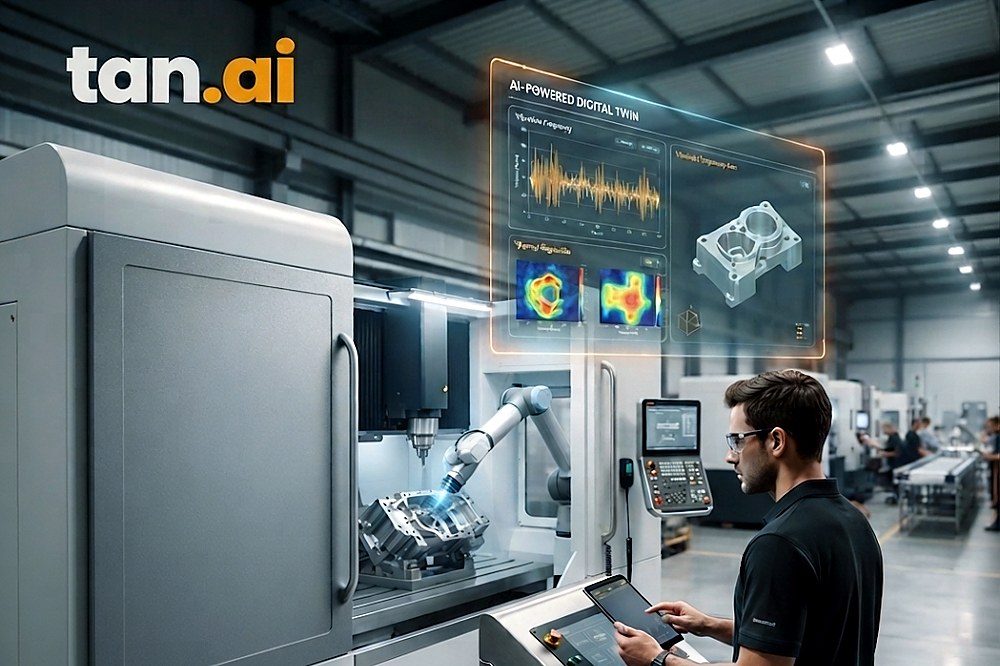
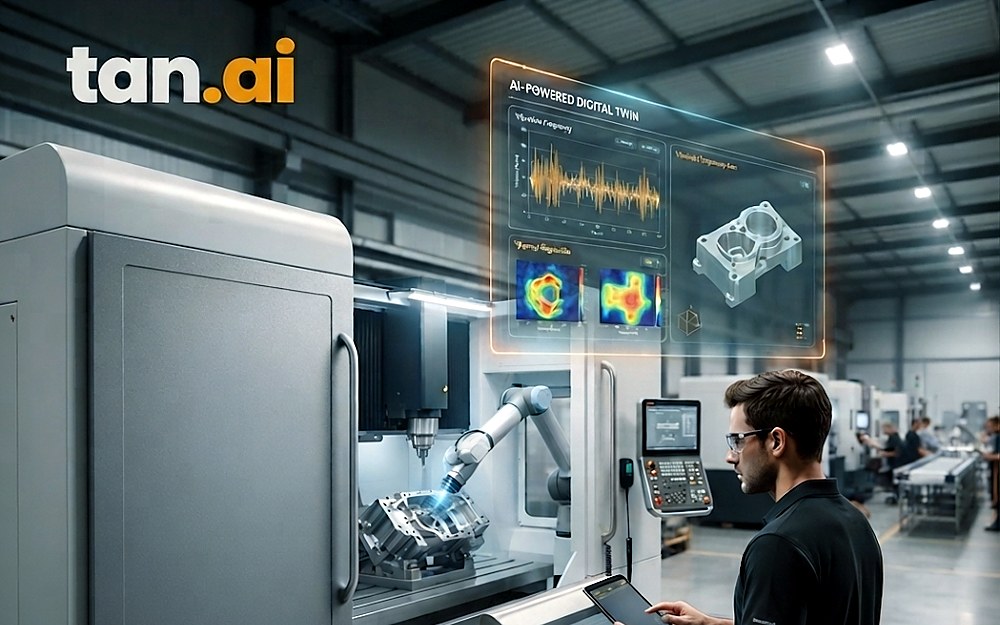
tan.ai AI-powered digital twin running beside a CNC machining cell, showing vibration frequency, thermal maps and the part model
What it is

Downtime is not an event. It is the end of a process you could have watched.

Every machine on your floor emits vibration, current draw, cycle time and thermal drift. Almost all of it is discarded within seconds of being produced.

tan.ai keeps it. It learns what normal looks like for your specific equipment — not a textbook average — and tells you when something is drifting away from it. That is the difference between a planned stop on Friday and a line down on Tuesday.

It grew directly out of our industrial IoT practice. Once a reliable pipeline exists off a machine, the interesting question stops being what is it doing and becomes what is it about to do.

Capabilities

Six things it does on a real shop floor

A digital twin of the cell, fed by the same sensors as the machine, running alongside the real thing.

tan.ai digital twin overlay showing vibration frequency, thermal maps and part geometry beside a live machining cell
AI-powered digital twin. Vibration frequency, thermal gradient and the live part model, side by side with the machine producing them.
01

Predictive maintenance

Bearing wear, spindle imbalance and tool degradation carry a changing vibration and thermal signature for weeks before anything fails. Models trained on your own equipment learn what normal sounds like, then raise a hand while it is still a maintenance job rather than a stoppage.

02

Machine vision inspection

Camera-based surface and dimensional checks running at cycle speed. It catches porosity, weld spatter, burrs and finish defects that a tired eye misses on the third shift, and keeps a labelled image record for every part you ship.

03

Generative design

Give it your load cases, material and manufacturing constraints. It returns geometry that hits the stiffness target at lower mass, and stays inside what your machines can actually cut — no shapes you cannot make.

04

Digital twin

A live model of the cell running alongside the real one, fed by the same sensors. Test a tool path, a fixture change or a new takt time against real production data before anyone touches the floor.

05

Process optimisation

Cycle time, scrap rate and energy per part tuned together rather than one at a time. The model proposes parameter changes and shows you the trade-off before you commit to anything.

06

Drawing intelligence

Dimensions, GD&T callouts and material specifications pulled out of legacy 2D prints and scanned drawings, then pushed into your PLM as structured data instead of being retyped by hand.

How it runs

Four stages, and every one of them has an exit

Nothing here asks you to rip out a control system or commit to a platform before you have seen it work.

01

Assessment

Two weeks. We look at what your machines already emit, what is being stored, and which decision would actually change if somebody could see it. You get a written finding either way — including "not yet worth it" if that is the honest answer.

02

Pilot

One cell, one question, one agreed measure of success. We instrument it, establish a baseline of normal operation, and run for a defined period. Nothing connects to production control during a pilot.

03

Roll-out

If the pilot holds up, we extend across the line or the site. Models retrain on your data as it accumulates, and the alert thresholds stay yours to adjust.

04

Operation

Your team runs it day to day. We keep the models honest as equipment ages and the product mix changes, because a model trained on last year's process quietly stops being right.

What you need already

  • Machines that emit something — most equipment made since roughly 2005 does, even if nobody is currently reading it
  • Somewhere to put the data, on premises or in the cloud. We can build this if it does not exist
  • One person who owns the outcome and can say what "better" means in numbers
  • A tolerance for a pilot that might honestly conclude the answer is no

What we will not claim

tan.ai does not predict failures it has never seen an example of. It needs a period of normal operation to learn from, and genuinely rare failure modes stay rare.

What it reliably catches is drift — the slow departure from normal that precedes most mechanical failures and nearly every quality escape.

And if the real problem is that nobody acts on the alerts you already have, more alerts will not fix it. We will say so during the assessment rather than after the invoice.

Where it applies

Any floor with machines worth keeping running

Automotive Aerospace Heavy equipment Machine building Medical devices Plastics & moulding Metal forming Foundry Packaging Electronics

Start with an assessment

Two weeks, one written finding, no obligation to continue.

Tell us what you're building.

Send a drawing, a problem statement, or a rough idea. An engineer replies — not an autoresponder.